


This page of your invoice details how your energy charges are calculated.
How to read your Alinta Energy business invoice
Need help understanding your invoice? This page explains where to find key pieces of information and what different parts of your invoice mean.
Bundled electricity invoice
Bundled Electricity 1
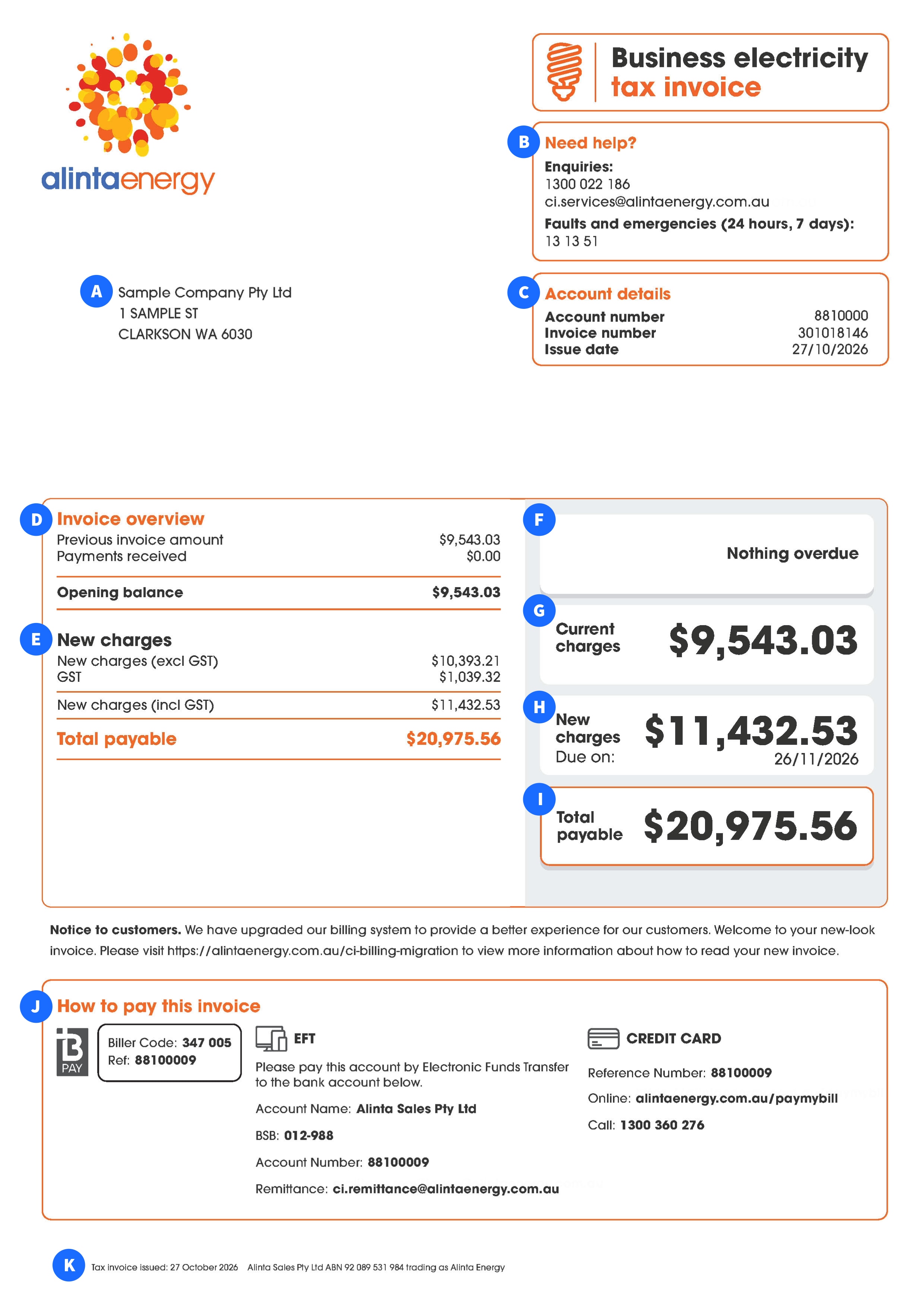
This identifies the business name and mailing address.
Our contact details including the number to call if there's an emergency or fault.
Your Alinta Energy Account details including your account number.
A list of previous invoice charges, payments and outstanding balances.
A summary of new charges by charge type exclusive of GST. The GST amount is listed as a separate line item. Total payable is the total of all outstanding charges.
Any overdue amounts from previous invoices will be shown here.
Balance from previous invoice not yet due.
The total of new charges for this invoice and their due date.
The sum of all charges payable shown at F + G + H.
Lists all available payment methods.
Invoice issue date and Alinta Energy ABN details.
Bundled Electricity 2
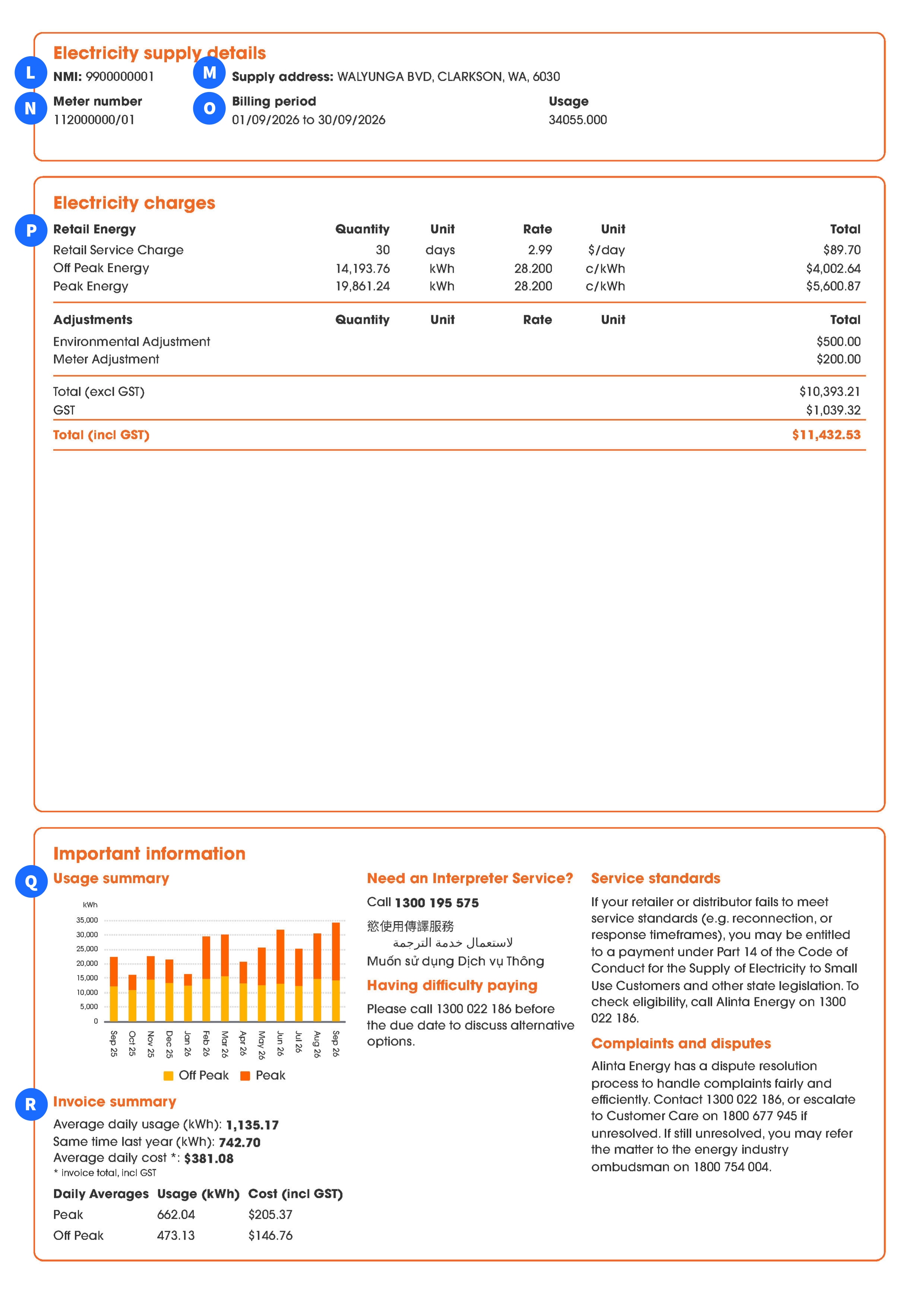
The National Metering Identifier (NMI) is the unique meter identifying number for your electricity connection point.
The address is the property where the energy is consumed.
Meter number(s) associated with the supply address. Your meter measures your energy consumption.
The supply period covered by the invoice for each meter, shown as a start date to end date.
The line summarises the total energy usage the site has consumed during this billing period and includes the price per kWh (kilowatt hour).
Peak: 8:00 am - 10:00 pm, Monday to Friday except public holidays in WA.
Off-Peak: all other times outside of peak hours.
Average consumption on a rolling month by month basis for a period of up to 12 months.
Daily averages for the billing period compared to same time last year.
Unbundled electricity invoice
Unbundled Electricity 1
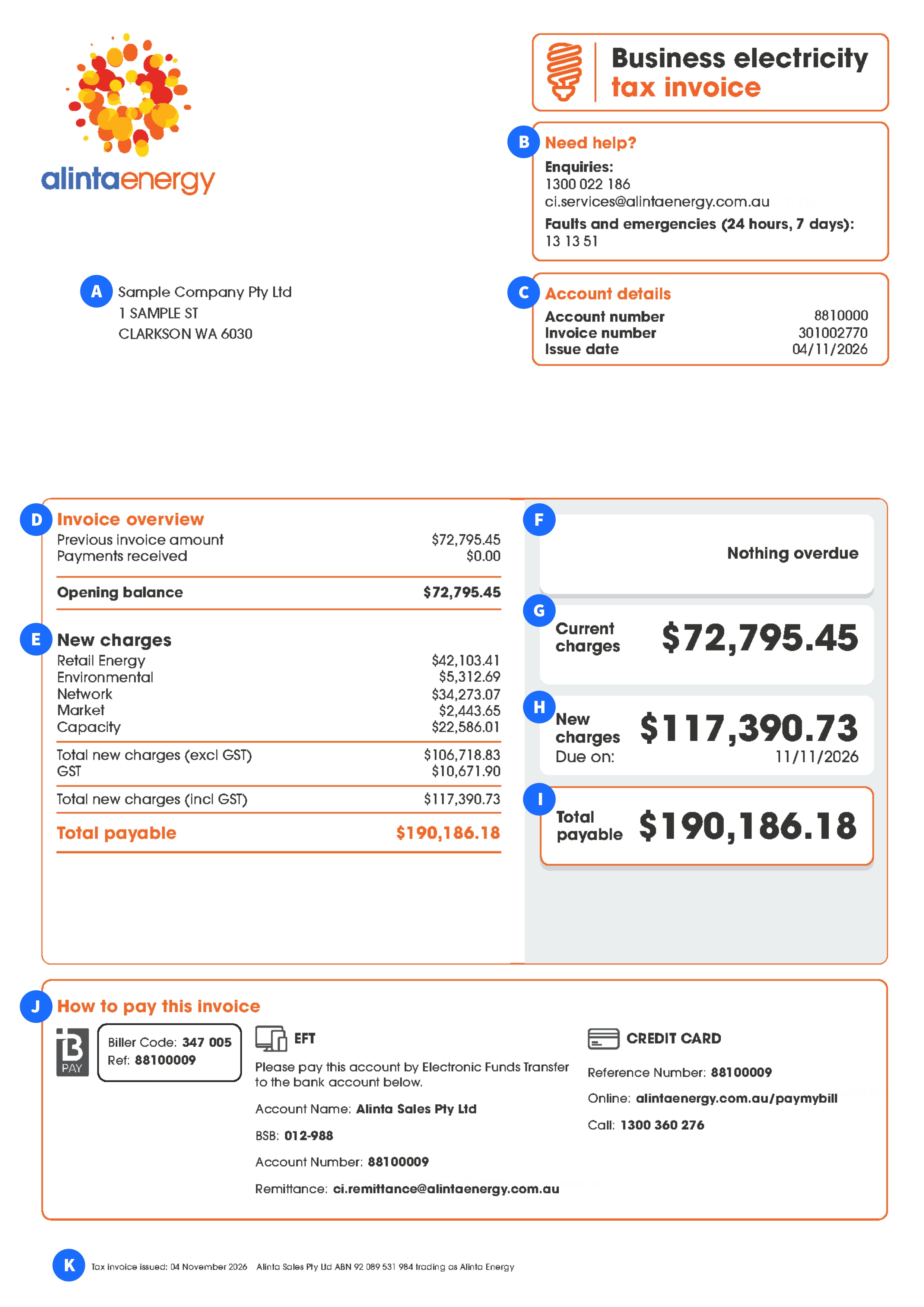
This identifies the business name and mailing address.
Our contact details including the number to call if there's an emergency or fault.
Your Alinta Energy Account details including your account number.
A list of previous invoice charges, payments and outstanding balances.
A summary of new charges by charge type exclusive of GST. The GST amount is listed as a separate line item. Total payable is the total of all outstanding charges.
Any overdue amounts from previous invoices will be shown here.
Balance from previous invoice not yet due.
The total of new charges for this invoice and their due date.
The sum of all charges payable shown at F + G + H.
Lists all available payment methods.
Invoice issue date and Alinta Energy ABN details.
This page shows your energy supply details and how your energy charges are calculated.
Unbundled Electricity 2
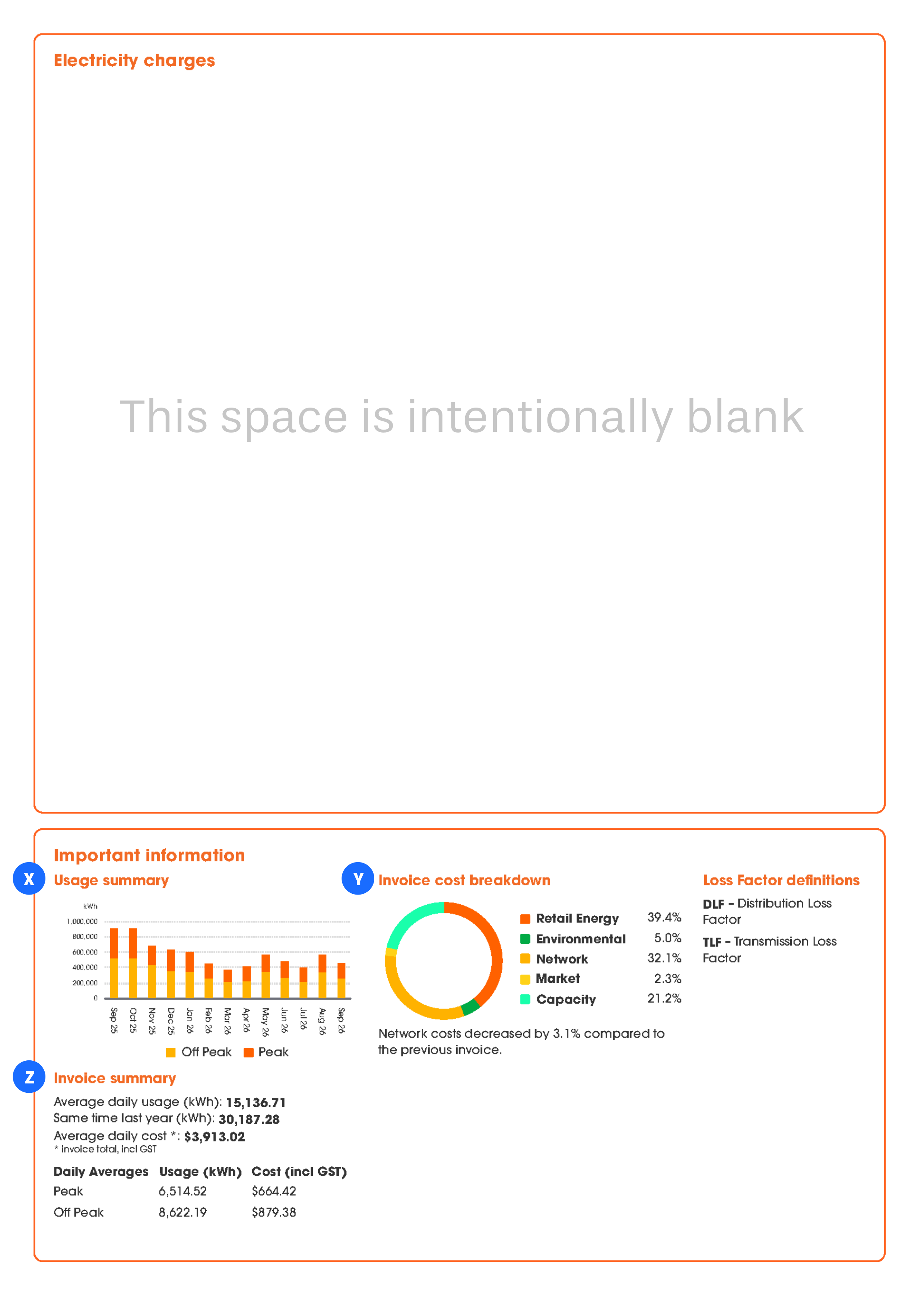
Unbundled Electricity 3
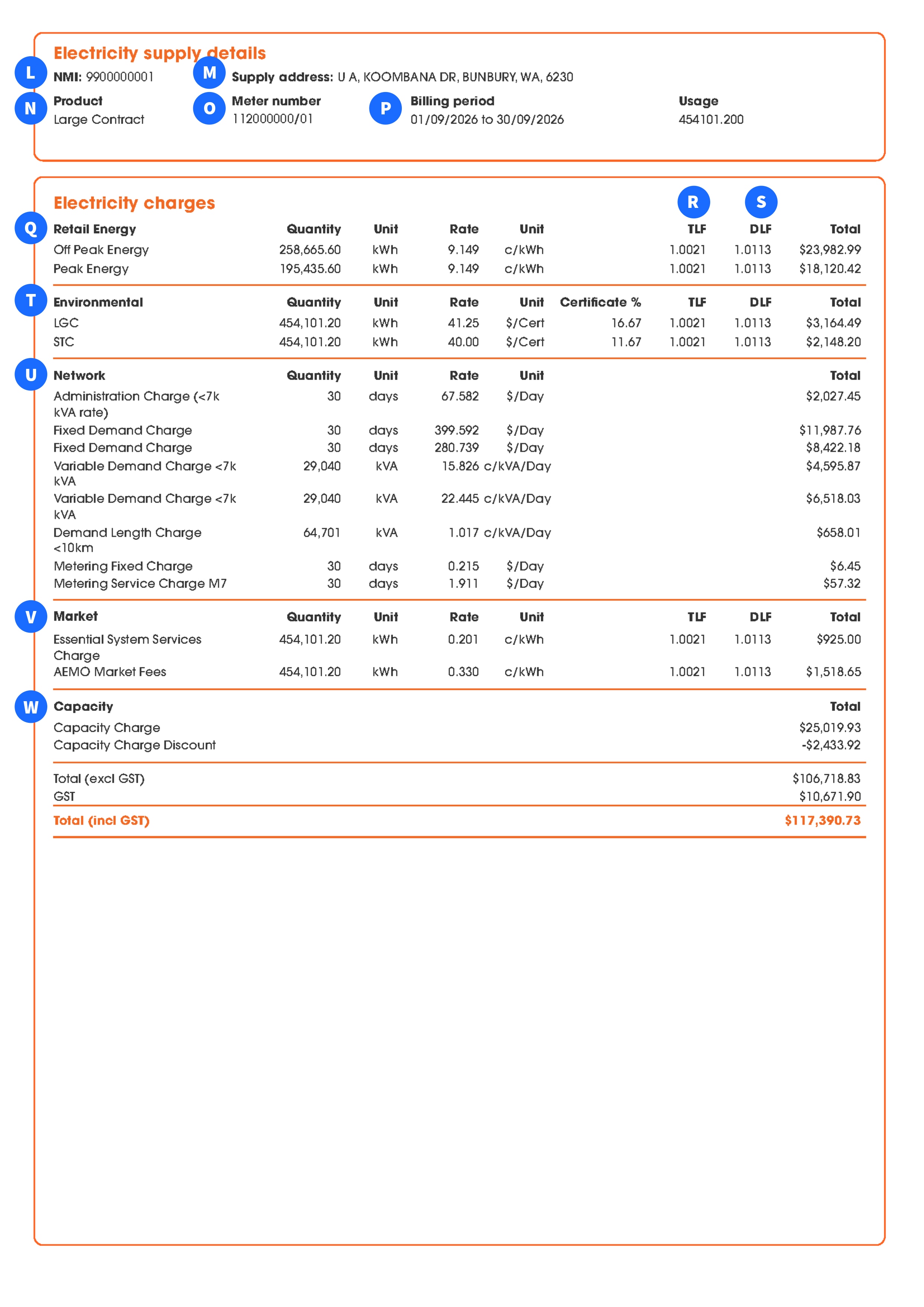
The National Metering Identifier (NMI) is the unique meter identifying number for your electricity connection point.
The address is the property where the energy is consumed.
This field identifies the product or pricing plan associated with your energy supply agreement.
Meter number(s) associated with the supply address. Your meter measures your energy consumption.
The supply period covered by the invoice for each meter, shown as a start date to end date.
The line summarises the total energy usage the site has consumed during this billing period and includes the price per kWh (kilowatt hour).
Peak: 8:00 am - 10:00 pm, Monday to Friday except public holidays in WA.
Off-Peak: all other times outside of peak hours.
Transmission Loss Factor (TLF) is the energy line losses from the transmission network applied to your consumption to compensate for losses incurred in the transmission of electricity between the generator and the transmission station.
Distribution Loss Factor (DLF) is the energy line losses from the transmission network applied to your consumption to compensate for losses incurred in the distribution of electricity from the transmission station to your site.
Costs allocated to environmental schemes that may apply at a federal level. These charges may have been specified in your Electricity Retail Sale Agreement.
The two charges that currently apply at a federal level are:
- LGCs — Large scale Generation Certificates
- STCs — Small scale Technology Certificates
Plus, GreenPower charges where you have opted to procure a portion of energy from renewable sources.
These are pass-through charges from Western Power for maintaining the network infrastructure and cover the costs of transporting electricity from power generation sources to your site.
These charges are set by Western Power, which operates the electricity distribution and transmission network in Western Australia.
Market charges are pass-through charges from Australian Energy Market Operator (AEMO) to cover market operating costs.
The Individual Reserve Capacity Requirement (IRCR) in the Western Australian Wholesale Electricity Market (WEM) is an obligation assigned to each market participant based on their contribution to the system peak, calculated monthly according to Appendix 5 of the Market Rules.
Average consumption on a rolling month by month basis for a period of up to 12 months.
Daily averages for the billing period compared to same time last year.
The percentage of new charges on this invoice by charge type.
Unbundled gas invoice
Unbundled Gas 1
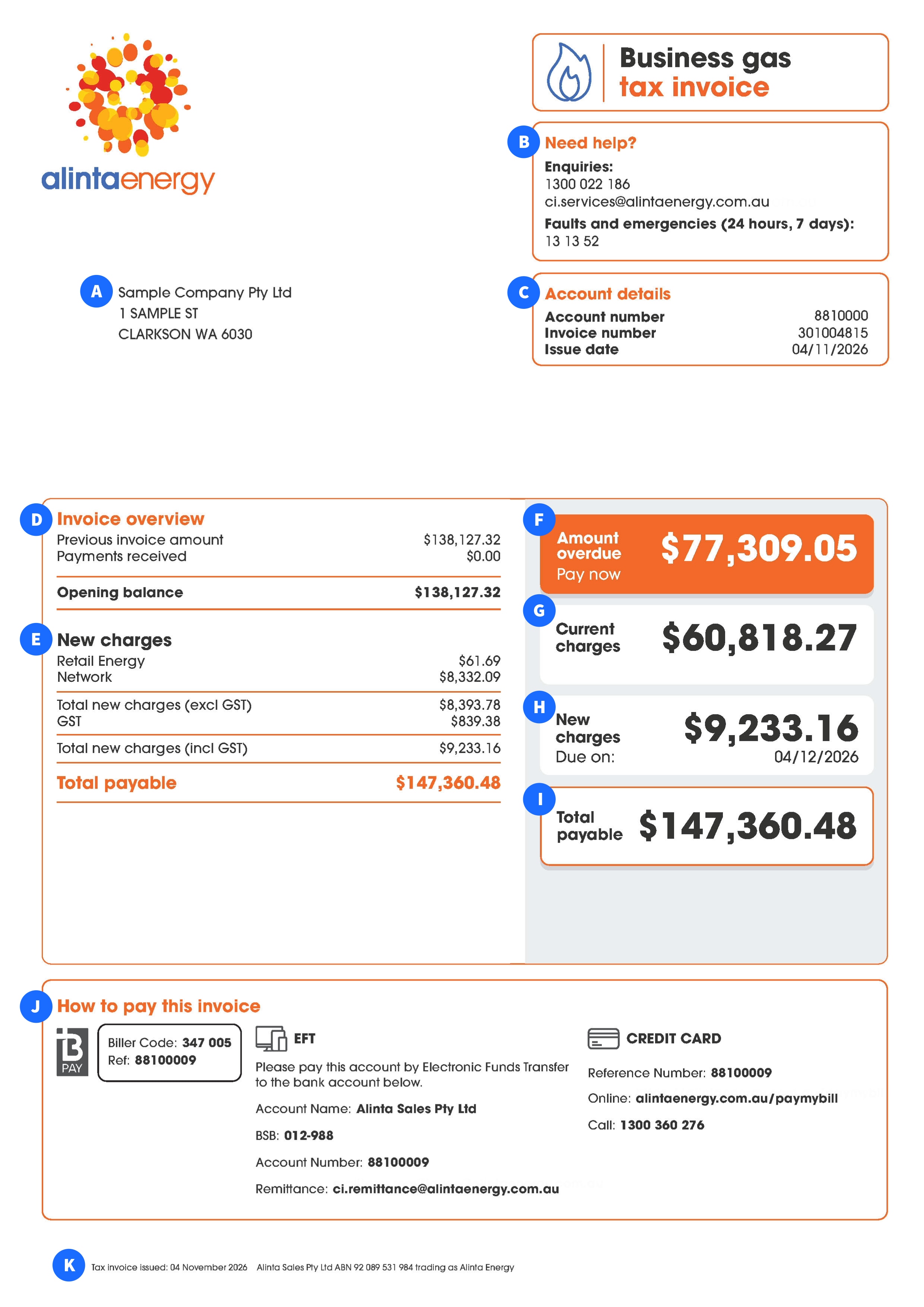
This identifies the business name and mailing address.
Our contact details including the number to call if there's an emergency or fault.
Your Alinta Energy Account details including your account number.
A list of previous invoice charges, payments and outstanding balances.
A summary of new charges by charge type exclusive of GST. The GST amount is listed as separate line item. Total payable is the total of all outstanding charges.
Any overdue amounts from previous invoices will be shown here.
Balance from previous invoice not yet due.
The total of new charges for this invoice and their due date.
The sum of all charges payable shown at F + G + H.
Lists all available payment methods.
Invoice issue date and Alinta Energy ABN dates.
This page shows your energy supply details and how your energy charges are calculated.
Unbundled Gas 2
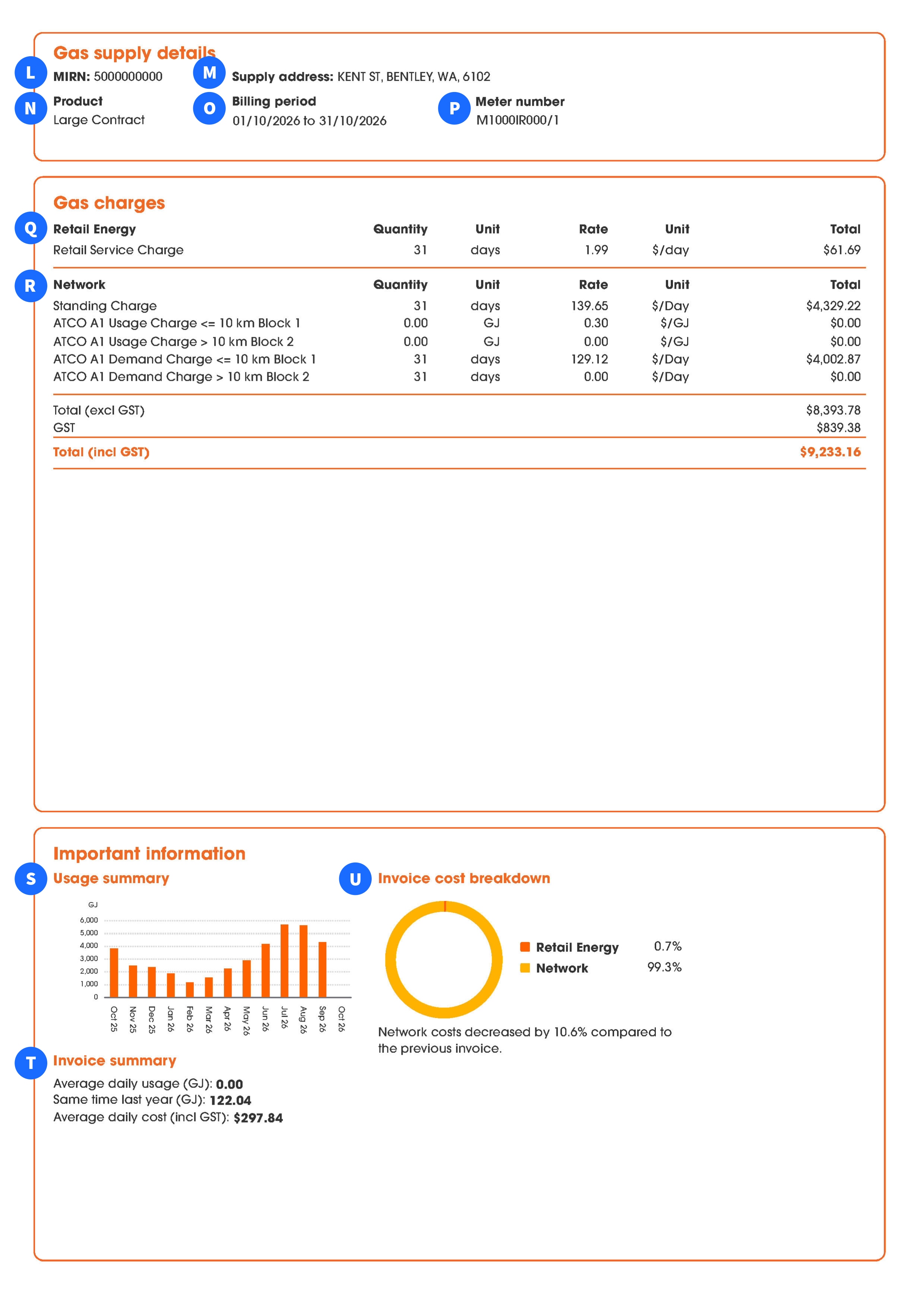
The Meter Installation Registration Number (MIRN) is the unique gas meter identifying number for your meter.
The address is the property where the energy is consumed.
This field identifies the product or pricing plan associated with your energy supply agreement.
The supply period covered by the invoice for each meter, shown as a start date to end date.
Meter number(s) associated with the supply address. Your meter measure your energy consumption.
Retail Service Charge: covers the costs of servicing the account and is a fixed daily rate.
Energy Charge: represents the cost of the gas used in this billing period, measured in gigajoules (GJ).
Standing Charge: a fixed daily fee that helps cover fixed infrastructure costs for operating the distribution network.
ATCO Usage Charge: a variable charge based on the amount of gas (GJ) consumed at the site. Covers the costs of delivering gas through the distribution network.
ATCO Demand Charge: covers the costs of delivering gas through ATCO's distribution network, which transports gas from high-pressure transmission pipelines to end users.
Average consumption on a rolling month by month basis for a period of up to 12 months.
Daily averages for the billing period compared to same time last year.
The percentage of new charges on this invoice by charge type.